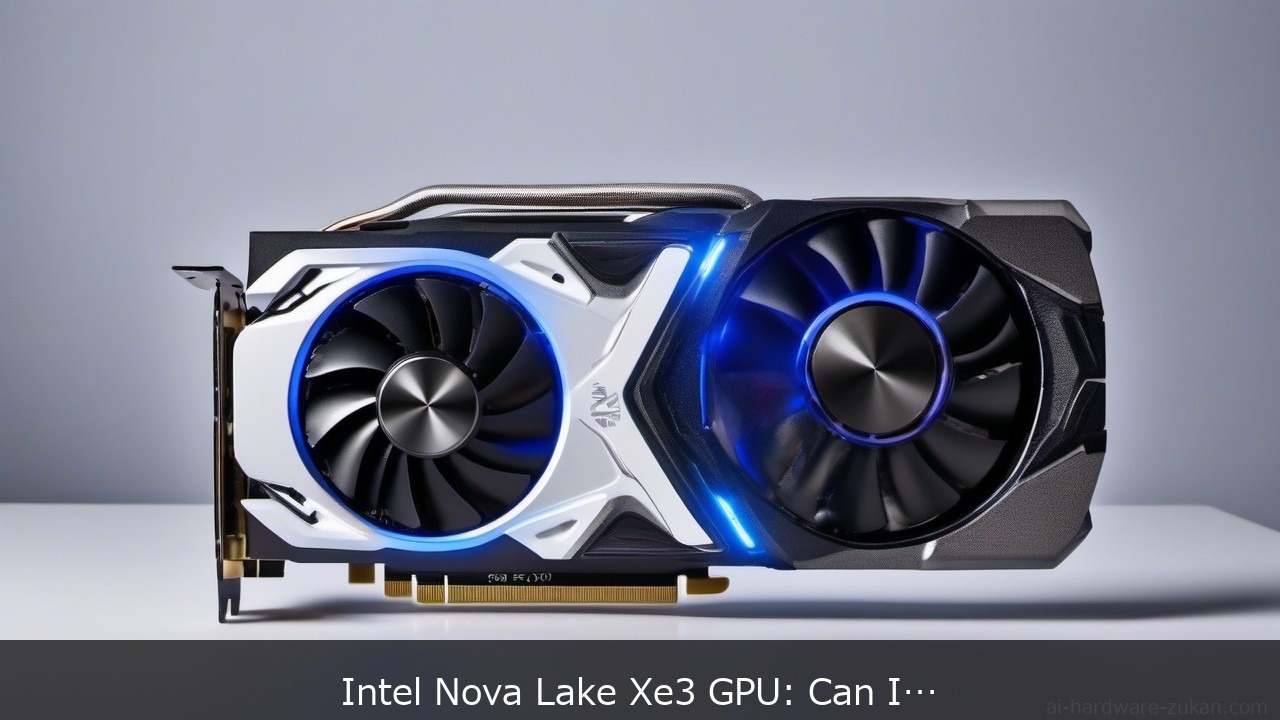
Leaked information suggests that Intel’s next-generation CPU, “Nova Lake” (Core Ultra 400 series), will feature a third-generation Xe3 integrated GPU (iGPU). Notably, it is reported to adopt a configuration that combines different generations of technology for the graphics engine and the media engine. Based on real-world data from the current Lunar Lake, we predict the capabilities of Nova Lake to determine how far local AI can run without a discrete GPU.
- Nova Lake is expected to feature an iGPU with a mixed-generation configuration: Xe3 graphics + Xe3P media engine
- Real-world tests of the current Lunar Lake (Xe2) show that quantized LLMs in the 4B class can run practically on the iGPU
- For running local AI without a discrete GPU, memory bandwidth and capacity are the primary factors determining performance.
Configuration of the Xe3 iGPU in Nova Lake
Intel Nova Lake is the next-generation CPU expected to launch as the Core Ultra 400 series. While the design of P-cores (performance cores) and E-cores (efficiency cores) is said to be significantly refreshed, the configuration of the integrated GPU has long been unclear. The positioning of the entire Core Ultra series officially rolled out by Intel can be confirmed on the Intel Core Ultra Processor Official Page.
In April 2026, Jaykihn, a leaker well-known for Intel roadmap leaks, revealed the integrated GPU configuration for Nova Lake. It will be equipped with a third-generation Xe3 graphics engine. This is said to use the same architecture as that adopted in the current Panther Lake (Arc B300 series). On the other hand, the engine responsible for display output and media processing is said to adopt Xe3P.
The Difference Between Xe3 and Xe3P — Why Separate Graphics and Media Engines?
One might wonder why the generational designations differ between the graphics and media engines.
The graphics engine (Xe3) handles shader processing and AI inference calculations, forming the core of GPU design. In contrast, the media engine (Xe3P) is a dedicated circuit for processing video encoding/decoding and display output. The generational classification of Intel Arc graphics and the positioning of Xe cores are organized on the Intel Arc Official Product Page.
These two components have different development cycles. The media engine is often developed in advance for discrete GPUs (dGPU)—i.e., standalone graphics cards—and then adapted and optimized for integrated GPUs. The “P” in Xe3P suggests a derivation from Panther Lake, and it is believed to be based on the media engine proven in the Battlemage generation dGPU.
From the perspective of AI applications, the benefit brought by the enhancement of the media engine is noteworthy. It may support hardware decoding for H.266 (VVC) in addition to AV1, potentially speeding up output processing in AI video generation workflows. In scenarios where generated videos are previewed and encoded in real-time, the performance of the media engine significantly affects perceived speed.
Reliability of Leak Information and Outlook for Official Announcement
Jaykihn is known as a leaker with a high hit rate regarding Intel roadmaps. However, the official announcement of Nova Lake is expected in the second half of 2026 to 2027, and the possibility of final specifications changing remains.
What is confirmed at this point is the “direction to equip a third-generation Xe3 graphics engine.” Specific specs such as the number of EUs (Execution Units = compute units) and operating frequency are still unclear. This article will estimate the performance range of Nova Lake based on real-world data from the current generation.
How Far Can the Current Lunar Lake iGPU Go for Local AI?
To predict the performance of Nova Lake, we first need to understand the “current state.” The current Lunar Lake (Core Ultra 200V series) is equipped with a second-generation Xe2 iGPU and has valuable benchmarks showing how practical local AI execution on an Intel iGPU is. The overall specifications of the Lunar Lake generation Core Ultra 200V series are published on the Intel Core Ultra AI PC Official Explanation, which outlines the assumed configuration where AI processing is shared among three systems: NPU, iGPU, and CPU.
In the r/LocalLLaMA community, performance comparisons of 8B class quantized LLMs using different GGUF quantizations in a Lunar Lake environment have been posted. This data is useful as it indicates the trend of the balance between speed and accuracy in executing local LLMs on Intel integrated GPUs.
Choosing AI Models and Quantization Methods for Lunar Lake
GGUF (GPT-Generated Unified Format) is a model format widely used for running LLMs locally. The format specifications and quantization algorithms are published on the llama.cpp Official Repository. Depending on the type of quantization (a technique that lowers the numerical precision of the model to reduce file size and memory usage), the balance between generation speed and answer accuracy changes significantly.
Real-world tests in a Lunar Lake environment have reported that Q4_0 quantization offers an excellent balance between speed and accuracy. On the other hand, it was confirmed that quantization methods like IQ2 and IQ3, which drastically reduce file size, tend to suffer significant accuracy degradation. The llama.cpp community continuously shares the following view on quantization accuracy comparisons:
Q4_0 and Q4_K_M have a small perplexity difference compared to Q8_0 in models below the 8B class and fit within the practical range even in environments with memory constraints. On the other hand, IQ2 series can cause catastrophic accuracy degradation in small models around 3B, making usage and verification essential. — llama.cpp Discussions (Quantization Thread)
Below is a table summarizing the characteristics of each quantization method for AI beginners.
| Quantization Method | File Size | Generation Speed | Accuracy (KLD) | Evaluation in Intel iGPU Environment |
|---|---|---|---|---|
| Q8_0 | Large | Slightly slow | Highest | Best option when memory is sufficient |
| Q4_0 | Medium | Fast | Practically sufficient | Good balance of speed, accuracy, and size |
| Q4_K_M | Medium | Fast | Equal to or slightly better than Q4_0 | A strong contender alongside Q4_0 |
| IQ3 Series | Small | Fast | Slightly degraded | A compromise for strict memory constraints |
| IQ2 Series | Smallest | Fastest | Significantly degraded | Not recommended as it sacrifices too much accuracy |
For reference, in our site’s test environment (RTX 5080 / i7-14700F / 96GB RAM), dGPU execution recorded 194.0 tokens/sec for gemma3:4b and 243.7 tokens/sec for phi4-mini:3.8b. On an integrated GPU, the speed would be about 1/10 to 1/5 of this, but for models in the 4B class, response speeds within a “waitable range” can be ensured. Detailed specifications for the Gemma 3 model series used in the verification are published on the Google Gemma 3 4B Model Card.
AI Inference on iGPU — The Constraint of Shared VRAM Memory
Integrated GPUs have a constraint that is decisively different from dGPUs (such as the GeForce RTX series). They do not have dedicated VRAM (video memory) and share system memory (RAM) with the GPU.
This means that the entire amount of installed RAM cannot be used for loading AI models. Since the OS and applications consume memory, even a laptop with 32GB of RAM will effectively have only about 15–20GB allocated to the iGPU. The amount of GPU allocation under a shared memory structure largely depends on the OEM’s BIOS settings and driver implementation, and the basic structure remains unchanged in the Lunar Lake generation.
Due to this constraint, the practical upper limit for executing local LLMs on Intel integrated GPUs is currently the 7B class (7 billion parameters). Models of 13B or higher do not fit into shared memory even when quantized, leading to extremely slow operation or failure to load altogether.
How Much Will AI Performance Improve with Nova Lake’s Xe3?
Having confirmed the “current state” with Lunar Lake’s real-world data, let’s consider how much performance will improve with the third-generation Xe3 in Nova Lake.
Expected AI-Related Enhancements in the Xe3 Generation
There are mainly three expected improvements in the transition from Xe2 to Xe3.
An increase in EU count is the first expectation. It is expected that the Xe3 in Panther Lake will have more EUs than the Xe2 in Lunar Lake. If parallel computing power simply increases, the tokens/sec for AI inference should also improve. However, the specific magnitude of improvement remains unknown until specifications are finalized. The Intel Arc B Series Product Page serves as primary information for the overview of Intel Arc’s Xe core generations.
Expansion of memory bandwidth is also a crucial factor. If Nova Lake supports LPDDR5x-8400 or higher, the data transfer speed, which tends to be a bottleneck in shared memory structures, may improve. AI inference, especially token generation speed for LLMs, strongly depends on memory bandwidth, so the effect of this expansion is significant. The LPDDR5x standard is officially defined in the JEDEC JESD209-5 LPDDR5/LPDDR5X Specification, with the latest revision standardizing up to 8533MT/s.
The third is the enhancement of the NPU (Neural Processing Unit = AI dedicated chip). In Nova Lake, the computational performance of the NPU is likely to be further increased, making the scenario of sharing AI processing among three systems (CPU + iGPU + NPU) more realistic. The overview of Intel AI Boost and NPU utilization scenarios for the Core Ultra generation is published on the Intel AI PC Official Explanation.
For specific usage division, LLM inference could be handled by the NPU, image preprocessing by the iGPU, and tasks involving API calls like ChatGPT or Claude by the CPU. If this is realized, each process could run in parallel.
How Far Can AI Run Without a Discrete GPU — Realistic Outlook by Use Case
How much can the “AI-compatible laptop without a discrete GPU” in the Nova Lake generation cover? We have organized the outlook by use case.
| AI Use Case | Outlook on Nova Lake iGPU | Notes |
|---|---|---|
| API usage (ChatGPT, Claude, etc.) | No problem at all | GPU performance is irrelevant. CPU, RAM, and SSD speed are important. |
| Claude Code, GitHub Copilot, etc. | Runs comfortably | API-based, so it does not depend on iGPU performance. |
| Local LLM (4B or less) | Runs at practical speeds | Q4_0 quantization recommended. Sufficient for chat purposes. |
| Local LLM (7B) | Operates, but speed is modest | 32GB+ RAM required. Memory bandwidth dictates speed. |
| Local LLM (13B or more) | Difficult for practical use | Insufficient shared memory capacity and bandwidth. dGPU recommended. |
| Stable Diffusion / ComfyUI | Hard to expect practical speeds | Minutes to tens of minutes per image. dGPU or eGPU connection recommended. |
| AI Video Generation | Not realistic | dGPU with 8GB+ VRAM is a de facto requirement. |
In short, API-based AI tools and coding assistance tools work without issues, and lightweight local LLMs also run. However, the structure remains that dGPUs are still necessary for image/video generation and running models with large parameter counts. If evaluating cloud API usage costs, Anthropic Claude’s pricing structure is published on the Anthropic Claude Official Pricing Page, allowing running costs to be calculated on a different axis from local GPU performance.
However, for uses such as “getting local LLM answers for simple questions while away from home” or “code completion with small models in offline environments,” Nova Lake’s integrated GPU should be a sufficiently practical choice.
Things to Watch Out for When Choosing a Nova Lake PC
Nova Lake is still some time away from release, but we want to organize the points to note when choosing a “PC that runs AI on an integrated GPU” now. This applies directly to choosing Lunar Lake-equipped machines as well.
Memory bandwidth is the most critical factor. Since integrated GPUs do not have dedicated VRAM, system memory speed directly translates to AI inference speed. LPDDR5x support is mandatory, and you should check if it is in a dual-channel configuration. Single-channel halves the bandwidth, causing a significant drop in LLM generation speed. The maximum bandwidth in the LPDDR5x specification was greatly increased in the JEDEC JESD209-5 revision, and implementations that take advantage of this limit are expected in the Nova Lake generation.
Memory capacity of 32GB or more is recommended. 16GB is insufficient for running 7B class LLMs. Considering the shared structure where memory is divided among the OS, apps, and model data, a generous capacity is necessary.
Checking the cooling design is also essential. Even if a high-performance CPU/iGPU is equipped, poor cooling mechanisms can cause thermal throttling (automatic performance limitation due to overheating), preventing the machine from demonstrating its true capabilities.
So, is an iGPU sufficient, or should you buy a model with a dGPU? The criterion for judgment is simple.
When iGPU is sufficient: Mainly using API-based AI tools (ChatGPT, Claude, GitHub Copilot, etc.). Using lightweight local LLMs (4B–7B) only as a supplement. When you want to keep the budget low or prefer a lightweight notebook.
When dGPU is recommended: When you want to generate images with Stable Diffusion or ComfyUI. When you want to run LLMs of 13B or more locally with comfort. When you want to challenge AI video generation. In our site’s test environment, RTX 5080 recorded 82.2 tokens/sec for gemma3:12b and 82.2 tokens/sec for phi4:14b, showing that the performance gap between dGPU and iGPU is dozens of times.
Organizing the Performance Gap Between iGPU and dGPU with Numbers
Even with the same LLM model, there is a large difference in generation speed between iGPU and dGPU. The table below compares the dGPU real-world values from our site’s test environment (RTX 5080 / i7-14700F / 96GB RAM) with the community-reported range for Lunar Lake-class iGPUs.
| Model | RTX 5080 dGPU (Our Site Real-World) | Lunar Lake iGPU (Estimated Range) | Ratio of Difference |
|---|---|---|---|
| phi4-mini:3.8b | 243.7 tokens/sec | 20–40 tokens/sec | Approx. 6–12x |
| gemma3:4b | 194.0 tokens/sec | 15–35 tokens/sec | Approx. 5–12x |
| gemma3:12b | 82.2 tokens/sec | Difficult to operate | — |
| phi4:14b | 82.2 tokens/sec | Difficult to operate | — |
The estimated range for iGPU is widened based on community reports from the Lunar Lake generation and the memory bandwidth ratio under the shared memory structure. In the Nova Lake generation, this lower-to-upper limit may be raised, but the dependency on dGPU for 14B class and above will not be resolved.
Summary
Nova Lake’s Xe3 integrated GPU is seen as a step forward in the era of running lightweight local AI models without a discrete GPU. As shown by Lunar Lake’s real-world data, quantized LLMs in the 4B class can achieve practical speeds even on an iGPU, and further improvements are expected in the Xe3 generation.
However, the reality remains that dGPUs are still necessary for LLMs of 13B or higher and image/video generation like Stable Diffusion. Local AI on integrated GPUs has its main battlefield in “lightweight inference to complement API-based tools,” and it is important to understand that it does not cover all heavy AI processing.
First, clarify the AI uses you want to pursue and check whether they fall within what the iGPU can handle using the guideline table in this article. After that, if you check the three points of memory bandwidth, capacity, and cooling design, you should not go far wrong in choosing a Nova Lake-equipped PC.
Frequently Asked Questions (FAQ)
Q: When will Nova Lake be released?
A: At this time, it is in the leak stage, and the official release date is undecided. Industry observations suggest the second half of 2026 to 2027 as likely, but we must wait for Intel’s official announcement. If you need a local AI environment immediately, considering a Lunar Lake-equipped machine or a dGPU notebook is a realistic choice.
Q: Will Stable Diffusion run on Nova Lake?
A: Practical image generation on the iGPU alone is hard to expect. Stable Diffusion (especially SDXL and later) is designed with the premise of a dedicated GPU with 8GB+ VRAM, and generation speed becomes extremely slow on an iGPU with a shared memory structure. If your goal is image generation, consider a model with a dGPU or an eGPU (external GPU) connection.
Q: Should I wait for Lunar Lake or Nova Lake?
A: If you want to start local AI immediately, a Lunar Lake-equipped machine is sufficient. Models in the 4B–7B class operate practically, and API-based AI tools can be used comfortably without issues. While Nova Lake promises improved iGPU performance, its release date is uncertain, so the “cost of waiting” must be considered. If you can wait more than half a year, it may be worth waiting, but you gain more by starting to use AI while waiting.
Q: What changes for the user in the difference between Xe3 and Xe3P?
A: Xe3 is the core responsible for AI inference and game rendering calculations, directly affecting LLM generation speed and 3D performance. Xe3P, on the other hand, is the media engine side, benefiting from hardware decoding support for AV1 and H.266. Users who perform AI video generation or watch/edit 4K streams will benefit more from Xe3P, while those who simply run LLMs will be more affected by the EU count of the Xe3 core and memory bandwidth.
Q: Which should I use to run LLM, NPU or iGPU?
A: Currently, it depends on the model and runtime. If the model is supported by Intel’s official OpenVINO or IPEX-LLM, NPU execution becomes power-efficient and high-performance. However, mainstream community tools like llama.cpp and ollama have prioritized iGPU (via Vulkan/SYCL) support. Until the versatility of the NPU expands, it is realistic to check the tool’s support status and use them appropriately.
This site is a participant in the Amazon Services LLC Associates Program. As an Amazon Associate, this site earns from qualifying purchases.
This article was written by the AI Hardware Zukan Editorial Department based on information available at the time of writing. Evaluations may change due to product updates or fluctuations in third-party benchmarks, prices, or supported runtimes. Re-verification is recommended for content that has aged.